800.942.4447


 Addresses
 Wallet
 Orders
 Invoices
 Item History
 Favorites
 Change Password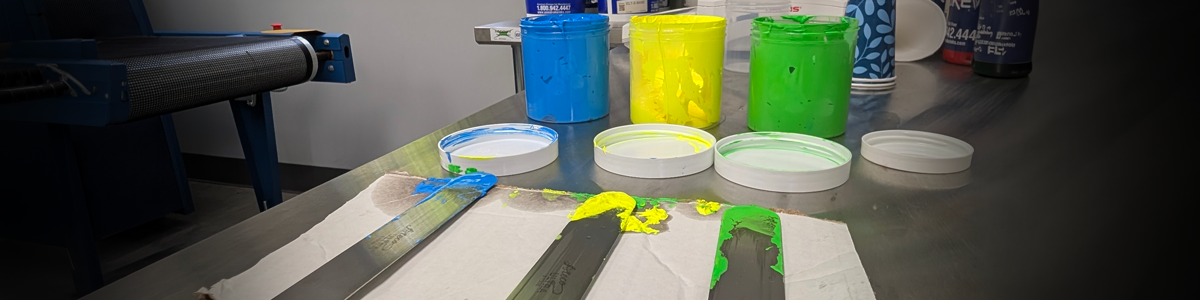
Good screen printing ink should do far more than look bright in the container. It should print predictably, hold the intended color, cure reliably, survive normal wear and washing, and perform the same way when the customer orders it again. Ink quality is not one feature. It is the combination of formulation, manufacturing control, testing, and repeatability.
At One Stroke Inks, we judge quality by whether an ink can be measured, printed, cured, compared, and reproduced. A formula on paper is only the starting point. The finished ink has to prove that it meets the standard.
Consistency And Viscosity Matter
A good ink should behave consistently from one container to the next. Printers should not have to completely change squeegee pressure, flood technique, mesh selection, or press speed every time they open a new drum of the same product and color.
Viscosity describes an ink's resistance to flow. It affects how the ink floods the screen, moves under the squeegee, releases from the mesh, and leaves the proper deposit on the garment. Ink that is too thick for its intended standard may require excessive pressure or print poorly through the recommended mesh. Ink that is too thin may become difficult to control or fail to deliver the intended deposit and opacity.
As part of our quality-control process, we take a sample cup from every drum and test its viscosity. We do not assume that using the same formula automatically guarantees the same press performance. The finished drum must meet the standard established for that particular product.
Color Accuracy Must Be Checked After Curing
Wet ink in an open container is not the final product. Color can appear different after the ink is deposited and cured, which is why a visual check in the bucket is not enough.
We take drawdowns from every drum, cure them, and compare the cured ink against the approved source color. Sometimes that source is a standard PMS color book. Sometimes it is a customer-provided sample or photograph, even something as personal and specific as the color of a child's eye. Whatever the approved standard may be, the cured drawdown must match it accurately.
Printers should still test the final garment because fabric color, underbases, ink deposit, and lighting can influence how a color appears. The important point is that color quality should be judged in a controlled, repeatable way rather than by glancing at wet ink.
Batch-To-Batch Repeatability Is A Quality Standard
An ink is not truly consistent if the first order is accurate but the reorder is noticeably different. Repeatability matters for school colors, corporate identities, team programs, memorial artwork, and any design that may be printed again months or years later.
We hold back a small portion of every ink we make as a retained sample. Our Color Vault now contains more than 30,000 retains from colors produced over the years. When a customer reorders an older color, that physical retain gives us the original ink as a historical standard rather than relying only on a formula name or computer record.
This is how we can guarantee color accuracy even years after the original order. The new ink can be evaluated against the customer's actual retained color before it leaves our facility.
Opacity And Color Strength Must Fit The Job
Opacity is the ink's ability to hide the fabric or color beneath it. Strong opacity is important when printing light colors on dark garments, but maximum opacity is not the only sign of quality. Some jobs need a softer print, finer detail, smoother wet-on-wet production, or a thinner ink deposit.
For example, our 480 Series is designed as an easy-to-print general-purpose plastisol for cotton and poly/cotton garments, especially on light fabrics or over a white underbase. It is also suited to wet-on-wet printing. When stronger coverage and bleed resistance are priorities, the .357 Series is formulated for high opacity and consistent color across demanding fabrics.
Good ink does not have to perform every possible job. It should perform the job it was designed to do and clearly identify the fabrics, mesh range, cure requirements, benefits, and limitations.
Good Ink Must Cure Reliably And Last
Screen printing ink must reach its required cure throughout the entire ink film. A print can look dry on the surface while remaining under-cured underneath. Under-cured ink may crack, peel, or wash away, while excessive heat can damage sensitive garments or increase dye migration on polyester.
A quality ink should have clear cure recommendations and produce a flexible, durable print when those instructions are followed. For printers who need a soft, stretchy, low-temperature option, our ELT-S Series is designed to combine low-temperature performance with a softer hand, particularly on cotton, poly/cotton, and stretchy polyester garments.
Cured samples should be allowed to cool and then evaluated with wash, stretch, and wear testing appropriate for the job. Polyester prints should also be observed after curing because dye migration may not appear immediately.
Printability Matters During Production
Ink quality also shows up in the way the product runs on press. Good ink should flood evenly, move cleanly under the squeegee, release from the mesh, and maintain a controlled print deposit. It should not require constant press adjustments when used as directed.
The exact feel will vary by product. A high-opacity white, a fine-detail color, and a soft-hand ink should not all have the same body. Quality means each product behaves predictably within its intended application.
What Our Every-Drum Testing Includes
Our quality-control process creates a check between the manufactured ink and the standard the customer expects. For every drum, we:
- Take a sample cup from the finished ink
- Test the viscosity against the product standard
- Produce a controlled drawdown
- Cure the drawdown before judging the final color
- Compare it against the approved PMS color, physical sample, photograph, or other source standard
- Retain a small portion so future orders can be matched to the original ink
These steps verify both present-day quality and long-term repeatability. They also give us a physical record of what the customer actually received.
How Screen Printers Can Evaluate Ink
Printers can apply the same basic principle on a smaller scale: test instead of guessing. Mix the ink thoroughly, print through the mesh and stencil planned for production, use the intended underbase and flash sequence, and test the actual garment whenever possible.
Heat-stable Pellons (Test Squares) are useful for setup and comparison prints, although final approval should be performed on the garment being decorated. Thermolabels can help verify and document dryer temperatures instead of relying on appearance alone.
After curing, allow the sample to cool and check it for color, opacity, adhesion, stretch, and surface quality. Wash testing should be performed before a new ink-and-garment combination goes into production. Keep records of the successful mesh, squeegee, flash, dryer, and ink settings so repeat jobs can be reproduced.
Final Thoughts
Good screen printing ink is accurate, consistent, printable, curable, durable, and appropriate for the application. Most importantly, those qualities must be measurable and repeatable. A bright first print is not enough if the next drum behaves differently or the reorder no longer matches.
At One Stroke Inks, testing a sample from every drum, curing and comparing drawdowns, and preserving more than 30,000 physical retains in our Color Vault allows us to protect the color our customer approved. Whether the standard is a PMS color, a company identity, or the color captured in a meaningful photograph, close is not good enough. Quality means producing the right result now and being able to reproduce it years later.